
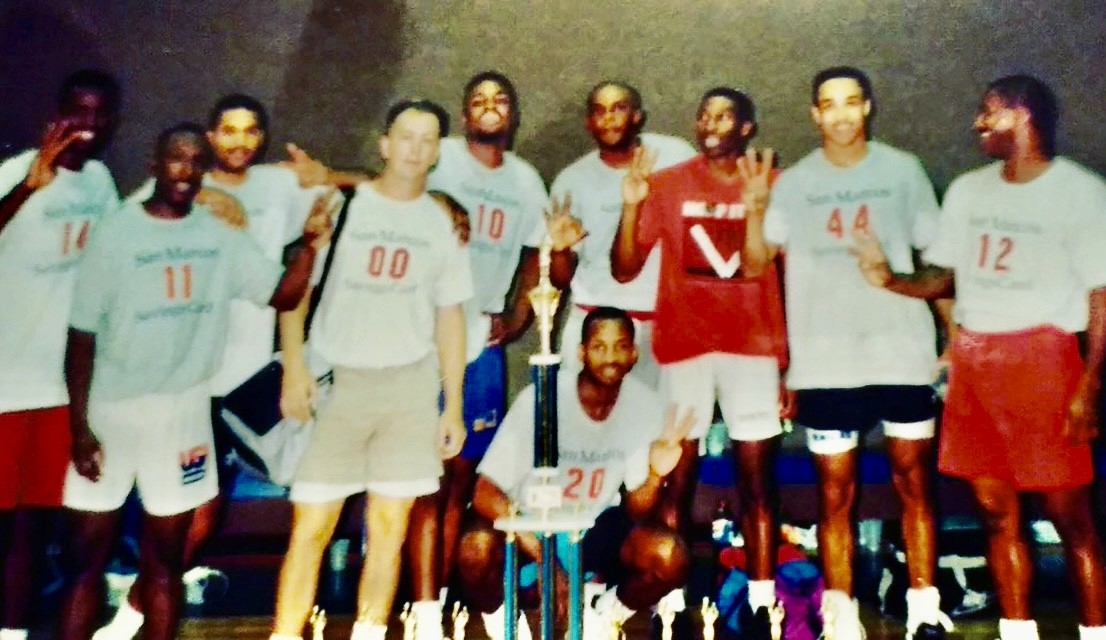
This old photograph was taken at Austin Aqua Fest in 1992, after we had won the tournament championship for the third consecutive year. That is why we are holding up three fingers. Held every August, the tournament drew teams from the Southwest Conference, professionals playing overseas, and usually five to fifteen NBA players. Yet what the photograph captures best is what basketball once gave us. We met while hooping in junior college - not through rankings, recruiting services, personal brands, or parents carefully managing our futures. We became friends, formed a team, and continued playing together for nearly ten years.
On the far left is Anthony Bowie. After being named the CBA's Most Valuable Player, he joined the Orlando Magic, where he spent five seasons - including four as Shaquille O'Neal's teammate. I am the white player near the center-left of the photograph. Second from the right is John Starks, who became an NBA All-Star just two years after this photograph was taken and later played in the 1994 NBA Finals.
Along the way, we won five championships. Several of my teammates eventually played in the NBA or other professional leagues. But when I look at this photograph today, the championships and professional careers are not the first things I see. I see friendship. I see joy. I see young men who chose one another and loved competing together.
Basketball later gave me the opportunity to play and coach at the college level. Now, after a lifetime around the game and years watching it as a parent, I keep recognizing the same troubling pattern - one that reaches far beyond basketball: parents’ anxiety frequently disguises itself as support.
Parents’ anxiety frequently disguises itself as support.
Most parents are acting from love. We drive to practices, pay for teams and trainers, rearrange family schedules, attend every game, and try to open doors. We tell ourselves we are helping. Yet love and anxiety can occupy the same seat, and anxiety often borrows the language of encouragement.
We track rankings, evaluate every possession, question playing time, promote our children, and speak confidently about the players they are destined to become. We say, “You should be starting.” “You are better than that player.” “The rankings are wrong.” “The coach does not understand you.” None of it sounds cruel. Much of it sounds supportive. But beneath that support, a child may hear a very different message: You must become the player I have told everyone you are.
That is too much emotional weight for any young athlete to carry.
Children notice more than we think. They read a parent’s face after a turnover. They feel the silence on the ride home. They know when praise is warm after twenty points and strained after two. Even if we never say that their value depends on performance, they may learn that the emotional weather in the family does.
Once that happens, the game becomes harder. Sport requires freedom - the ability to read, react, improvise, fail, and recover. A player cannot do that while mentally standing beside himself and judging every movement. When every possession seems connected to a ranking, a scholarship, a parent’s mood, or the ride home, the child is no longer simply playing. He is managing what the game means.
He passes up an open shot because missing would feel too revealing. He forces another because he needs to prove he belongs. He looks toward the stands after a mistake. Adults may respond by saying, “Stop thinking. Be aggressive. Just play.” But a child cannot be commanded into freedom while feeling constantly evaluated.
Let the coaches evaluate performance. Let home restore perspective.
That is why emotional safety is not softness. The athlete who knows love will remain steady can risk more, learn faster, and recover sooner. He can receive coaching without hearing condemnation. He can lose today without deciding who he will be tomorrow.
Parents often fall in love with a future version of their child: the starter, the ranked player, the scholarship athlete, the confident college student. Hope is part of parenting. The trouble begins when the imagined child becomes more important than the child standing in front of us.
The present child may not yet have the strength, maturity, discipline, or confidence the future seems to require. He may develop later than expected. His dream may change. When we insist that children perform as their future selves before they are ready, potential becomes a debt they are always failing to repay.
Real support can hold high standards and still honor an honest timeline. It says: I see what you could become, but you do not have to become it today to deserve my delight.
The ride home after a game may be the place to begin. A young athlete is tired, emotionally exposed, and already aware of most of his mistakes. A parent is also activated, full of observations and eager to help. That is precisely why restraint matters. Not every silence needs to be filled. Not every lesson needs to be delivered before leaving the parking lot.
A simple sentence - “It was good to watch you play” - can do more than an immediate technical review. Later, if the child wants to talk, we can ask: “What did the game feel like to you?” or “Is there anything you want from me?” Those questions return ownership to the athlete.
The harder work belongs to the parent. We must ask ourselves: What am I afraid will happen if my child is not the best? What does his success prove about me? Why does his disappointment make me so uncomfortable? Am I helping him pursue his dream, or asking him to carry mine?
Those questions are not accusations. I have spent enough years inside basketball - as a player, a coach, and a parent - to know that none of us gets this exactly right. I have been guilty of allowing that same anxiety to disguise itself as support. I have watched a game too closely, worried too much about what a performance might mean, and carried concerns that should never have belonged to my child. Recognizing that in myself is part of why I believe this matters so deeply. The goal is not to care less. It is to become secure enough that our children do not have to perform in order to stabilize us.
At some point, every parent must give the game back to the child. The uniform belongs to the athlete. The minutes belong to the coach. The ranking belongs to whoever creates the list. But the relationship between parent and child belongs to both of them - and it is worth more than any of those things.
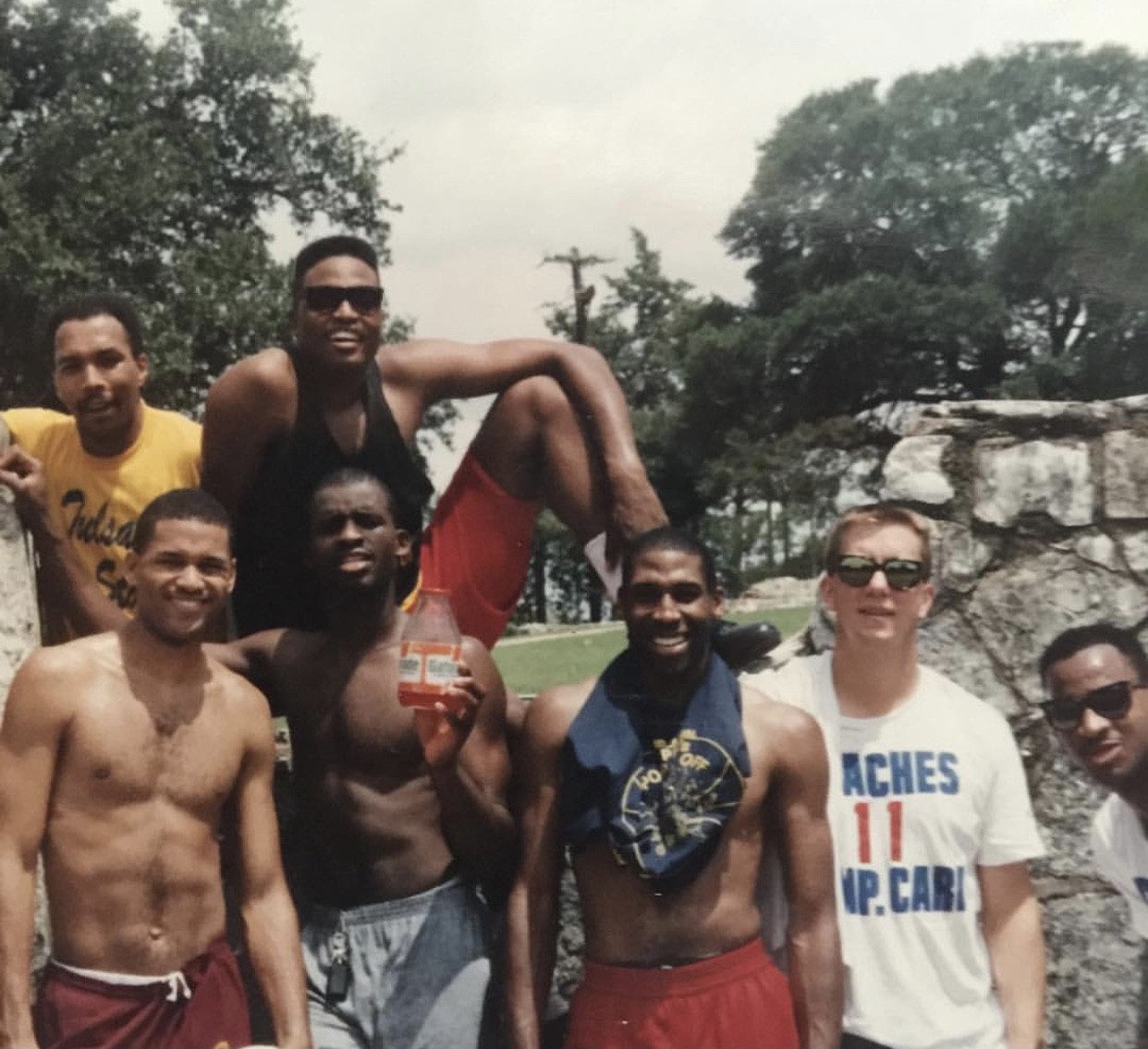
The men in that old photograph achieved more than we could have predicted when we first began playing together. But nobody engineered it. We were given room to compete, form friendships, fail, improve, and discover who we were. Friendship came first. The accomplishments followed.
Oh, and if you absolutely insist on ranking us: for about a decade - from the mid-1980s through the early 1990s - we were the baddest dudes playing basketball in Austin, Texas.
Perhaps that is what today’s young athletes need most - not parents who care less, but parents secure enough to hover less. Let the coaches coach. Let the rankings come and go. Let home be the place where a child’s value never changes.
Give the game back to the kids. Then watch what grows.